|
|||
 |
 |
 |
 |
|
|||
|
|
|
|
 |
 |
|
|
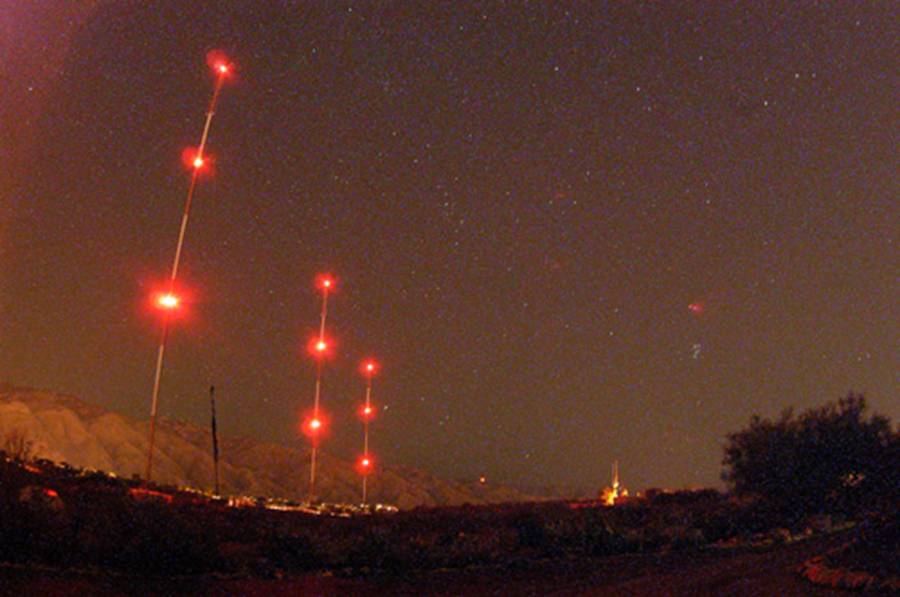
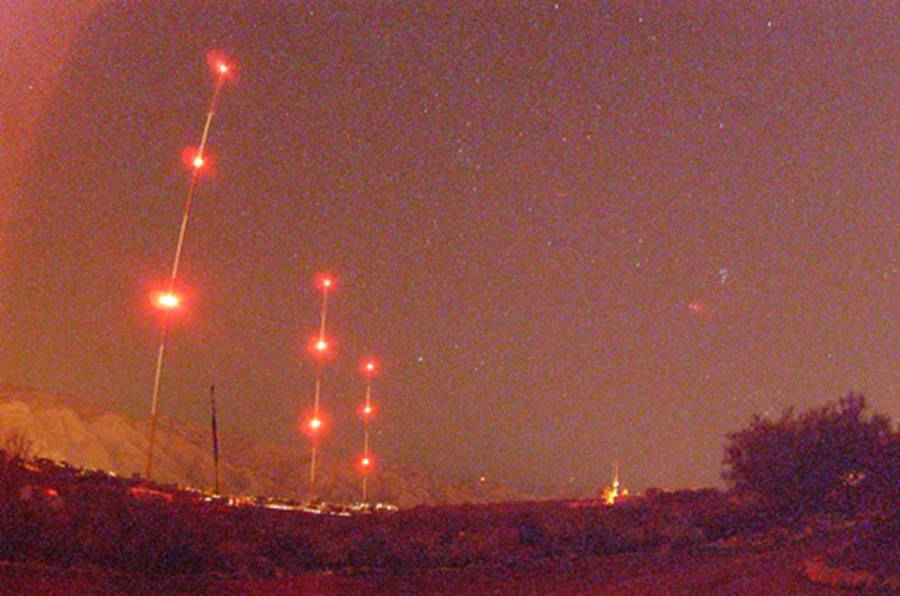
Schedler (2004) reports that a Canon 10D digital camera can take exposures as long as 5 minutes at ISO 1600 without objectionable noise. More recent experience at the Grasslands Observatory with the Canon 20Da and especially the Canon 60Da has proved that mulitple exposures of ten minutes at ISO 3200 do not produce objectionable noise under most ambient conditions. With regard to the Nikon D100, I generally limit my exposures to two minutes or less due to image degradation from light pollution if I am imaging in the city or due to trailing from unguided exposures. On colder nights, the Nikon D100 will take exposures of 5 minutes or longer with acceptable noise levels, and it can take a series of 10-20 exposures without too much accumulation of camera heat and degradation of the images. On cold nights the main factors affecting image quality are battery life, the amount of sky glow from light pollution, and the quality of the tracking system used with the camera. On warmer nights, image deterioration from one successive image to another can rapidly degrade the images as shown by figures 29-30:
Figure 29. First image of a sequence of 24 consecutive 60 second exposures with a 16 mm f/4 lens, ISO 800, air temperature 250 Celsius. Original untouched image. No dark subtraction or noise reduction applied. Compare this image to figure 30.
Figure 30. Last image of a sequence of 24 successive 60 second exposures with a 16 mm f/4 lens, ISO 800, air temperature 250 Celsius. Original untouched image. No dark subtraction or noise reduction applied. Compare this image to figure 29. .
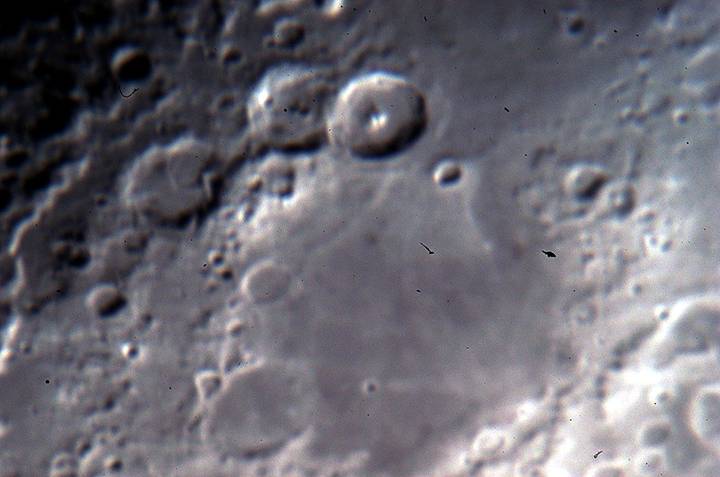
No flat images are applied to most digital SLR images. It is possible to perform flat fielding on these images in the same fashion as with any other digital astronomical image. Flat fielding is generally not performed, because good flat images are difficult to make, and they usually do not sufficiently improve an image to be worth the effort. Also, DSLR images are not used for scientific measurements, because the digital data for these cameras is probably unreliable, and it has not been standardized; thus, there is no requirement for accurate bias, dark, and flat field image processing. Unfortunately, dust does accumulate on the window protecting the camera chip, and it can show up on resultant images, particularly if there is a bright sky background or a large bright object, such as the Moon (figure 31):
Figure 31. Two power Barlow projection of the Moon at the prime focus of a Meade 12 inch f/6.5 LX 200 telescope. One-thirtieth second exposure, ISO 1600. Note the black specks that overlie Mare Nectaris in the center of the image. These are caused by dust on the Barlow lens and the CCD chip cover. The three craters north of (above) Mare Nectaris are left to right Catherina, Cyrillus, and Theophilus. T. Hunter.
It is possible to clean dust specks from in front of the CCD or CMOS chip in a digital camera, and there are web sites that describe how to do this. If the dust specks are not too numerous or bothersome, they can be ignored, made invisible by adjustment of the image contrast, or digitally removed by an image processing program, such as Photoshop.
C. Battery Life The Nikon D100 uses a single rechargeable Nikon EN-EL3 lithium-ion battery. At 200 Celsius, approximately 1600 shots can be taken using the lens sequence, file sequence, and camera operation as defined in the Nikon handbook for the camera (Nikon, 2002). In practice, considerably fewer images can be taken on a fully charged battery when the camera is used for astrophotography. The exposures are typically much longer, and the camera is used at night in much colder temperatures. Long exposures, repeated rapid exposures one after the other, and colder temperatures greatly reduce the battery life. In my experience, a fully charged battery used for exposures of 10-60 seconds on a night with the ambient temperature near 100 Celsius will last for two hours of photography or approximately 100 exposures. Fortunately, the battery can be fully recharged in two hours, and the camera was purchased with an extra battery so that a fully charged battery is always available for photography. The camera will not operate without a sufficiently charged battery.
D. File Types The Nikon D100 camera offers 14 file types for image output, including Nikon Electronic Image Format (NEF, a RAW proprietary file), TIFF file format, and JPEG file format. These come in a several modes involving differing image compression and image sizes from large to small and “fine” to “basic”. The default format is normal, large JPEG which creates a file with a size of approximately 1.6 MB. The highest quality TIFF file has a size of 17.638 MB, while the RAW file has a size of 9.4 MB (Nikon, 2002). Many authorities recommend use of RAW files for maximal image quality (Schedler, 2004). However, there are considerable disadvantages to RAW files. First, they are large and difficult to manipulate and to store. Second, they are proprietary from one camera to the next, and they require, for the most part, proprietary software from the camera manufacturer. For example, NEF files can only be viewed in Nikon View 5 or Nikon Capture 3. RAW files, in general, can not be manipulated by general image processing software, such as Photoshop or Corel Photo-Paint unless one has the latest versions of these programs. The large, uncompressed, TIFF images are well defined and can be used by any general image processing program. Unfortunately, they are very large and are difficult to manipulate and store compared to the much smaller JPEG images. However, TIFF images and RAW images can be processed and later stored and converted to smaller JPEG or GIF images once their useful information has been maximally displayed. A number of objects have been imaged with both TIFF and JPEG images and the results compared. It has been my subjective impression that there is not enough difference between the large TIFF files and the smaller 1.6 MB JPEG files to warrant the use of the large TIFF files or the large RAW files in most cases with the Nikon D100. The smaller JPEG files have excellent quality if they are properly taken, and most of the images displayed herein were taken with the 1.6 MB JPEG format. The images taken at the Grasslands Observatory with the Canon 60Da are initially saved and processed as RAW images to obtain maximum image quality.
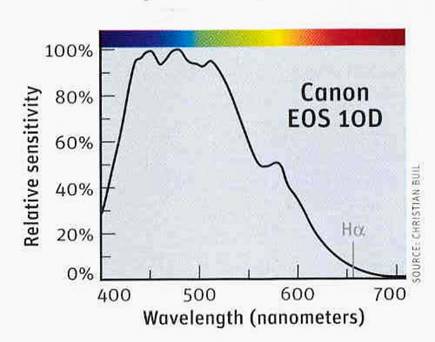
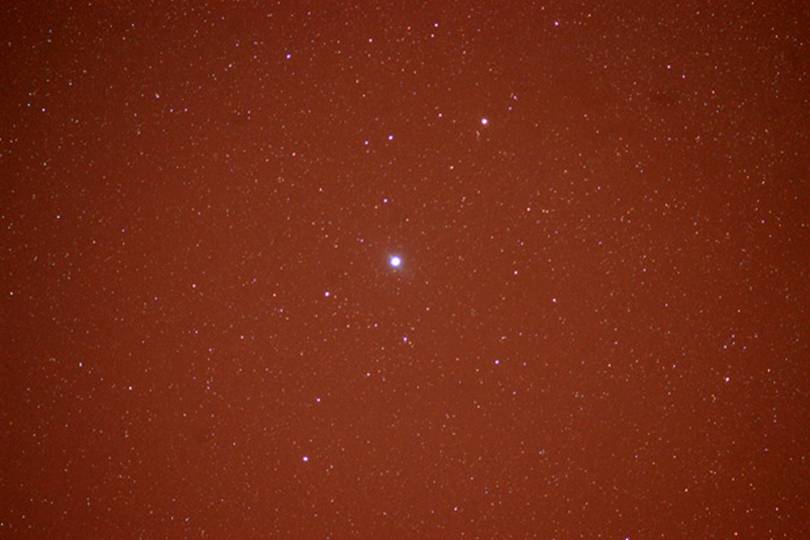
E. Poor Red Response Only the Canon 20Da and 60Da cameras were designed specifically for astrophotography. All other digital cameras were not designed for astophotography and have generally poor sensitivity in the far red portion of the visible spectrum (Schedler, 2004). The hydrogen-alpha line at 656 nm is not well portrayed, which makes imaging of emission nebulae and hydrogen-alpha regions in galaxies difficult with most DSLR's. The blue portions of the spectrum are better portrayed by these cameras (figure 32). Nevertheless, light pollution can add a significant red or yellow tint to the sky background on unprocessed DSLR images (figure 33):
Figure 32. Sensitivity of the Canon EOS 10D SLR chip versus wavelength. From Schedler (2004).
Figure 33. Sixty second exposure, ISO 1000, with 135 mm f/3.5 lens centered on Altair. Untouched original image. T. Hunter. Field of view is approximately 7 x 10 degrees. North is up. Faintest visible stars on the original image are 12th magnitude. The sky color is red due to light pollution from Tucson.
Interestingly, the chips used by these cameras are, in fact, quite sensitive to red light and near infrared light (Schedler, 2004). Unfortunately, an infrared blocking filter has been placed over the imaging chip to obtain proper daytime color balance. This works greatly to the advantage of the mainstream photographer and to the disadvantage of the astrophotographer, but from the manufacturers’ point of view there are significantly more mainstream photographers than astrophotographers. Hutech Astronomical Products sells digital SLR cameras with the infrared blocking filter removed or with the manufacturer’s filter replaced by a different filter which allows better hydrogen-alpha sensitivity (Hutech, 2004). If the infrared blocking filter is completely removed, the camera can only be used for astrophotography. Some digital SLR cameras use complementary metal-oxide semiconductors (CMOS) instead of CCD chips. CMOS chips are cheaper to manufacture and use less power. In general, they can not substitute for the CCD chips found in standard astronomical CCD camera systems, but they work well in digital cameras (Schedler, 2004). Canon, Kodak, Fuji, and other manufacturers have also introduced digital SLR cameras with chips the same size as 35 mm film (24 x 36 mm), but they are somewhat expensive, and the chips in these cameras contain 11 to ~ 30 million pixels producing very large image files.
|Back| |Next|
|
||
 |
|||
Copyright © 2013 The Grasslands Observatory. All rights reserved. |
|||