|
|||
 |
 |
 |
 |
|
|||
|
|
|
|
 |
 |
|
|
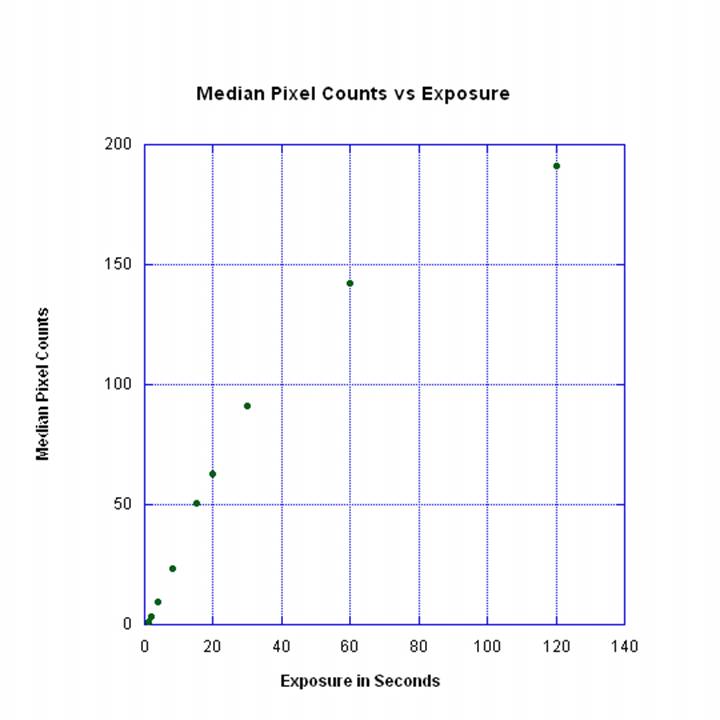
F. Miscellaneous Considerations The Nikon D100 and many other digital cameras allow for video operation. This is not useful for astrophotography, because inexpensive web cams can perform the same function far better in most cases (Jones, 2004). However, multiple exposures from a digital camera can be put together to form an animated image. An example of such an image may be found at http://www.3towers.com/ObservatoryImages/LeonidsA.gif. This shows an animated view of Leonid meteors from the 2002 meteor shower. While the current generation of digital SLR cameras can not be used for photometry, the Nikon D100 shows a generally linear response with short exposures. A series of exposures of the region around Altair was taken with a 135 mm f/3.5 lens piggybacked onto a 12 inch Meade LX 200 telescope to prevent star trailing. The exposures were 1, 2, 4, 8, 15, 20, 30, 60, and 120 seconds, ISO 1000, and they were repeated twice. The Nikon noise reduction routine was used for each image. The software program Mira Pro 7 (Axiom Research) was used to analyze each image, and the median pixel count for each image was plotted versus the exposure length (figure 34):
Figure 34. Plot of median pixel count versus exposure length for a series of 135 mm f/3.5 lens exposures centered on Altair. The evening temperature was 250 Celsius. The Nikon D100 camera was piggybacked onto a Meade 12 inch LX 200 telescope to prevent star trailing.
For exposures somewhat under 60 seconds the median pixel count is linearly related to the exposure length. Multiple images with the same exposure length showed median variations of 1-2 counts between images, depending on the exposure length. For all the images, the mean and median pixel counts for the individual exposures were within 1-2 counts of each other. These results are limited and can not be generalized, because they will vary with changes in ambient air temperature and sky conditions, but they do indicate a general stability and reproducibility of this camera for exposures from 1-60 seconds. Special shutter release equipment is available for the Canon and Nikon DSLR cameras for programming a series of multiple exposures (Aguirre, 2001; Hanson, 2004; Nikon, 2002). This allows for an automatic operation of the camera and for direct connection of the digital camera to a computer. Computer control of the camera then permits a more remote control of the camera, and it also permits use of software packages that help with camera focusing. I personally have not had trouble with manual focusing for most images, because the Nikon's view finder gives a sufficiently bright image for focusing. Tripod mounted shots with a simple camera lens work well if the lens is set at infinity. Focusing of the camera for objects viewed through a telescope is more difficult, especially if they are faint and do not contain easily recognizable point sources. Schedler (2004) recommends DSLR Focus for Canon digital cameras.
VII. Conclusions Digital SLR cameras are wonderful tools that can be adapted for all astrophotography applications (Table 1), but they can not replace standard astronomical CCD systems, and they have a variety of limitations related to their image size, their lack of thermal cooling, and their dependence on short lived batteries. However, they have revolutionized astrophotography for the amateur. The future is very promising. Technology is constantly improving digital cameras, and their prices are falling. We are just seeing the beginning of this fascinating era of digital imaging.
Table I – What General DSLR Cameras Can and Can Not Do Well (Astronomically) Can Do Well Daylight Photography – observatories, observing sites… Enlargements – 10 x 12 inches; 14 x 17 inches Tripod Photography – short exposures up to a few minutes Piggyback Photography – short exposures up to a few minutes Lunar, Solar, Planetary Photography – {web cams are probably better} Prime Focus Telescope Imaging – reasonable substitute for more expensive astronomical CCD cameras Can Not Do Well Enlargements beyond 14 x 17 inches Repeated exposures in rapid succession – gradual image deterioration Long exposures in cold temperatures – rapid battery failure Multi-hour star trail exposures Prime Focus Telescope Imaging for faint objects – most galaxies and nebulae are beyond easy reach of digital cameras Can NOT match the speed and efficiency of standard astronomical CCD camera systems
First written 11 November 2004 Edited and Posted 27 September 2009 Further revision 15 June 2014
| Back |
References Aguirre E. Astroimaging with digital cameras. Sky & Telescope August 2001; pages 128-134. Carpenter EF, Jepperson R. Color photography of faint objects with a special fast film. AJ 1959; 64: 49-50. Covington, MA. Astrophotography for the Amateur. Cambridge University Press, 1999, Cambridge, pages 93, 219. Hanson M, Greiner RA. Equipment review. Canon 10D digital camera. Astronomy 2004; September: 84-87. Hunter TB, McGaha JM, Knauss JD. Halley's Comet, The Pleiades, and Murphy's Law. Deep Sky, Fall 1986. Hutech Astronomical Product web site at: http://www.sciencecenter.net/hutech/. Jones G. Web cam images and discussion at: http://www.threebuttes.com/webcam.htm Kelso TS. NORAD Two-line element sets. Current data. at: http://celestrak.com/NORAD/elements/ Michaud P. Capturing star trails with a digital camera. Sky & Telescope March 2004; pages 126-131. Miller WC. First color portraits of the heavens. National Geographic May 1959; pages 670-679. Nikon D100 Digital Camera. Product Documentation. 2002. Palcholka W. Personal communication. Web site at: http://www.astropics.com/. SatCalc View at: http://www.nerosoft.com/SatCalcView.asp Seronik G. SLR camera adapters. Sky & Telescope September 2004: pages 106-107. Schedler J. Astro imaging with digital SLR cameras. Sky & Telescope June 2004; pages 130-138.
|
||
 |
|||
Copyright © 2013 The Grasslands Observatory. All rights reserved. |
|||