|
|||
 |
 |
 |
 |
|
|||
|
|
|
|
 |
 |
|
|
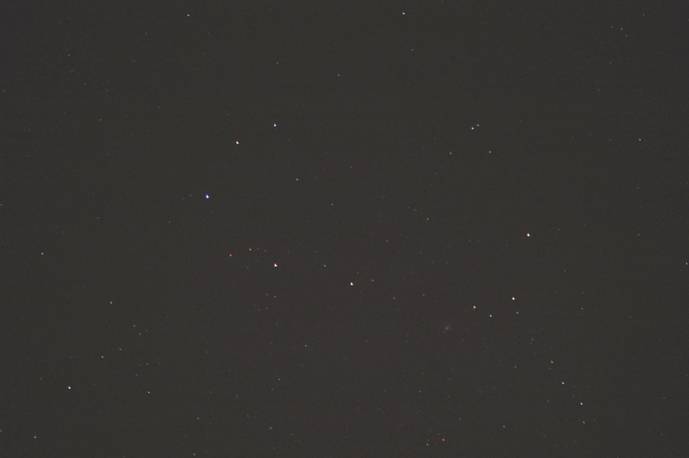
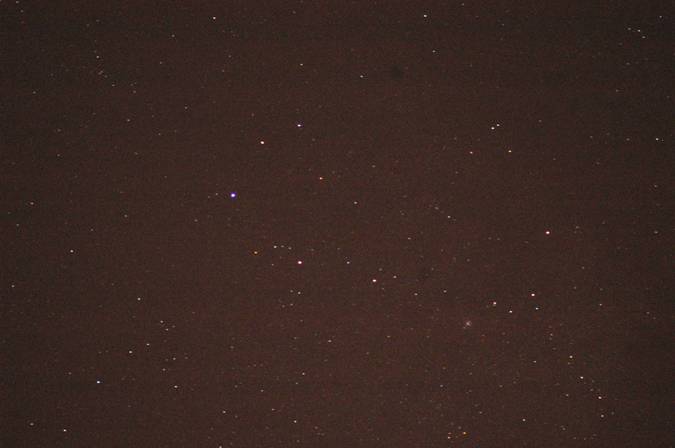
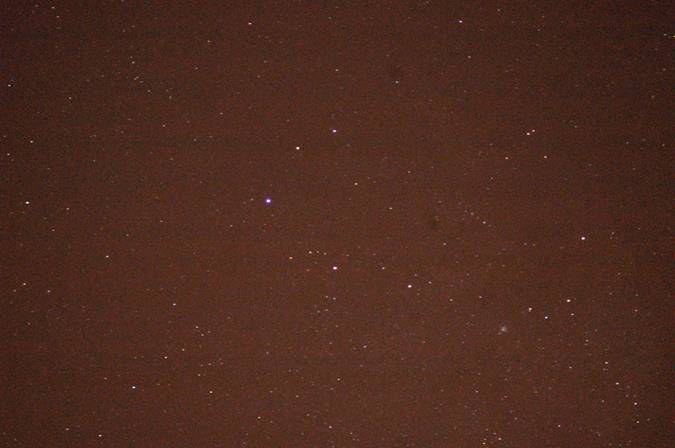
VI. The Nikon D100 Camera: Some Technical Considerations A. Film Speed Digital single lens reflex 35 mm cameras offer all the advantages of standard film SLR cameras, one of which is the ability to adjust “film speed” or ISO values. The International Standards Organization (ISO) specifies many standards. ISO 5800:1987 specifies how to measure film speed for color negative film. Many other film speed standards, such as the American National Standards Association Institute (ANSI) standard exist, but they are now considered to be the equivalent of the ISO standard. It is well recognized that the fastest ISO films do not necessarily produce the best astrophotography results. Fast films may have more noise, emphasize the sky glow from light pollution more readily, have more color shift, and, in general, may produce a less pleasing result than a slower film that has better contrast, definition, and color rendition. The Nikon D100 camera allows ISO selections from 200 to 6400 and initial imaging was performed using the ISO set at 1600. This worked well as shown by some of the above images. Testing was then performed to determine which ISO setting is most efficacious. Five-second exposures were taken of the star field centered at Delta Cepheus and of the star field centered on Lambda Aquilae. The Delta Cepheus field is in a dark part of the sky for the north side of Tucson where I live and where my home observatory (3towers Observatory) is located. Lambda Aquilae lies in the southern part of my sky where there is considerable light pollution from the center of Tucson to the south of my home. The images of both star fields were taken with respective ISO settings of 200, 400, 800, 1000, 1200, 1600, 3200, and 6400 using a 135 mm f/3.5 mm lens with a field of view of 10 x 7 degrees. The images were then examined for their limiting magnitude, color rendition, and overall pleasing effect. With both star fields, ISO settings of 800-1000 produced the best results as shown by the following examples which have been maximally adjusted for display here (figures 24-26): ISO 400:
Figure 24. Star field centered on Lambda Aquilae. Five second exposure with 135mm f/3.5 lens, ISO setting 400. Note: star colors are observed, and the open cluster M11 may be seen. T. Hunter.
ISO 1000:
Figure 25. Star field centered on Lambda Aquilae. Five second exposure with 135mm f/3.5 lens, ISO setting 1000. Note: star colors are observed, and the open cluster M11 may be seen. T. Hunter.
ISO 3200:
Figure 26. Star field centered on Lambda Aquilae. Five second exposure with 135mm f/3.5 lens, ISO setting 3200. Note: star colors are observed, and the open cluster M11 may be seen. T. Hunter.
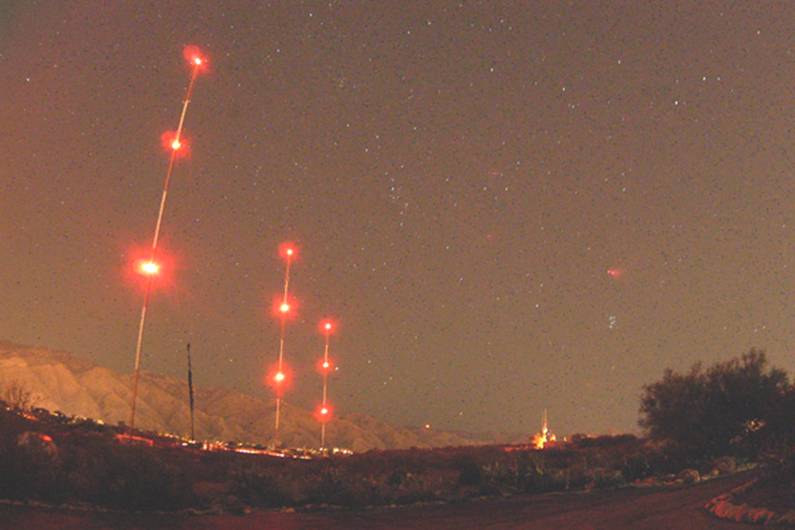
B. Dark Subtraction Thermal noise affects all CCD chips, including those in digital cameras (Schedler, 2004). For exposures longer than one-half second, the Nikon D100 will accumulate significant noise which shows up as randomly spaced bright colored pixels (Nikon, 2002). Thermal noise can be reduced in several ways. If the camera is cooled, thermal noise decreases. There is no built in mechanism with commercial digital SLR cameras for chip cooling. However, ingenious amateur astronomers have devised ways to cool their digital SLR cameras (Schedler, 2004). Since much astrophotography takes place in cool nighttime temperatures, the cameras are naturally cooled by the ambient environment. The typical temperature for nighttime photography in Southeastern Arizona is 10-150 Celsius, though the Nikon D100 has been used for temperatures below zero Celsius. This greatly reduces thermal noise, but it also reduces the battery life. Another way to reduce thermal noise is to take a series of dark frames and combine them with a median routine to produce a master dark frame to subtract from the image frame. This works well for standard CCD astrophotography, and it is possible with digital SLR images. The Nikon D100 camera, on the other hand, has an optional noise reduction routine that takes a dark image of the same exposure length after the standard exposure has been taken. This dark image is then subtracted by the camera firmware to produce the final resultant image. I have used this method for most of the images presented in this essay. This routine has the advantage of being taken at the same time, temperature, and battery condition as the original image frame, and it is automatically performed by the camera. Dark images obtained as part of a master series will usually be taken at different temperatures and battery condition and may not be as accurate as the built in noise reduction technique. The noise reduction technique also has a built in bias frame that is applied at the same time. The major disadvantage of the noise reduction technique is that it more than doubles the time required for an exposure, and it uses up half the battery charge for dark images (figures 27- 28):
Figure 27. Sixty second exposure with 16 mm f/4 lens, ISO 800. Image produced from a 60 second raw image combined with a 60 second dark image. T. Hunter.
Figure 28. Sixty second exposure with 16 mm f/4 lens, ISO 800. Image produced with Nikon Noise Reduction Technique automatically turned on. T. Hunter.
| Back | | Next |
|
||
 |
|||
Copyright © 2013 The Grasslands Observatory. All rights reserved. |
|||