|
|||
 |
 |
 |
 |
|
|||
|
|
|
|
 |
 |
|
|
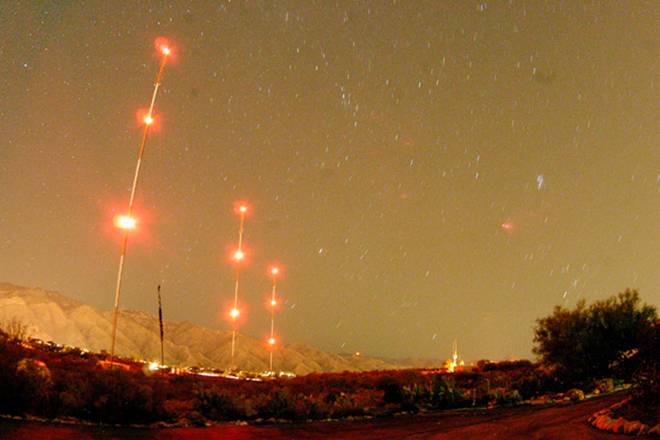
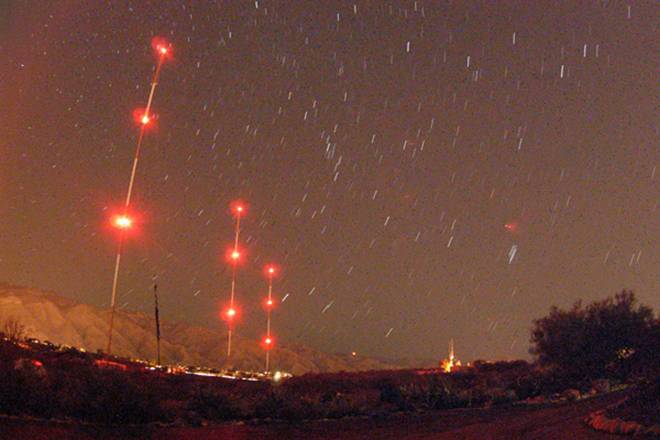
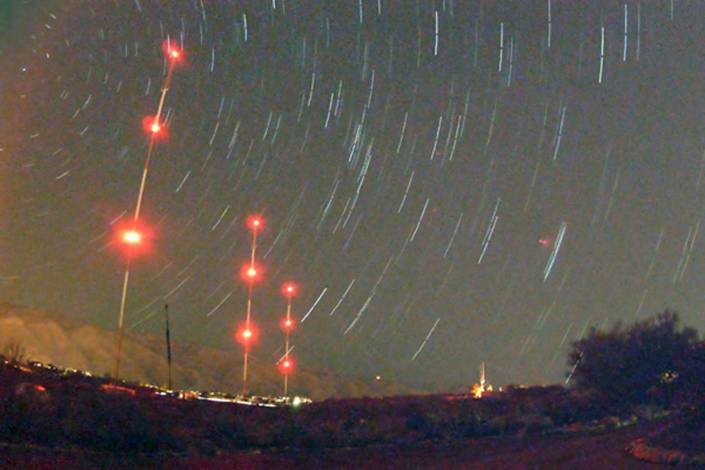
Michaud (2004) developed an interesting technique for using a digital SLR camera to produce long exposure star trails. Individual short exposures (1-2 minutes) are combined in Photoshop (Adobe Systems, Inc.) using Blend and Lighten modes; this has the effect that the sky brightness never increases beyond that present in the brightest single image (Michaud, 2004). The more images added to the stack, the longer the star trails that can be produced. This has the potential for very dramatic images, because the sky background does not gradually brighten as it does with long exposures on film, and any illuminated foreground object does not necessarily become overexposed. On the other hand, this technique requires considerable computer expertise and also requires multiple short exposures which can become bothersome if one has to attend to each exposure. It is also necessary to keep the pauses between exposures short to reduce potential gaps in the star trails. An electronic shutter release that can be programmed to take a sequence of exposures is available for some cameras and is useful for long exposure star trails. Figures 13-15 illustrate this technique:
Figure 13. Star Trails. 300 second exposure with 16 mm f/4 lens, ISO 800. Single exposure with Nikon D100 digital camera using built in camera dark subtraction. The dome of the 3towers Observatory is evident in the lower left hand corner. Untouched original image with no corrections. T. Hunter.
Figure 14. Star Trails composed from five successive 60 second exposures added together using the technique of Michaud (2004), ISO 800, Nikon D100 digital camera with 16 mm f/4 lens. The dome of the 3towers Observatory is evident in the lower left hand corner. Untouched original image with no corrections. T. Hunter.
Figure 15. Star Trails composed from fifteen successive 60 second exposures added together using the technique of Michaud (2004), ISO 800, Nikon D100 digital camera with 16 mm f/4 lens. Polaris is evident in the upper left hand corner of the image. Note the short break in the star trails from a delay between two successive exposures. The dome of the 3towers Observatory is evident in the lower left hand corner. T. Hunter.
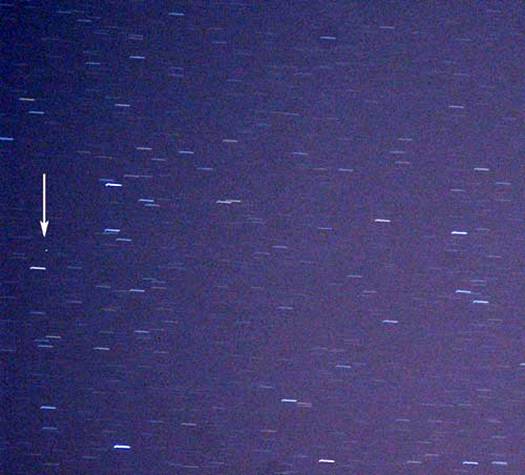
B. Geosynchronous satellites There are a large number of geosynchronous satellite and many web sites devoted to satellite observing. Orbital elements for geosynchronous and routine artificial Earth orbiting satellites are available from the North American Aerospace Defense Command (NORAD) and can be downloaded directly into TheSky6 software program (Software Bisque) for displaying a geosynchronous or other satellite against the background stars (Kelso, 2004). Another software program SatCal is useful for computing the altitude and azimuth of a geosynchronous satellite for a given location on the Earth. This utility is designed to calculate exactly where to point a satellite dish in order to detect a selected geosynchronous satellite (SatCal, 2004). TheSky6 and SatCal were used to image Geos11 from Tucson, Arizona. A two minute exposure demonstrates Geos11 as a tiny dot set against the background stars which are trailed (figure 16):
Figure 16. Geos11 geosynchronous satellite (arrow) as observed from Tucson, Arizona. Two minute exposure with 135 mm f/3.5 lens, ISO 1000. Star trails demonstrate the Earth’s rotation, while the pinpoint image of Geos11 shows it is fixed in a geosynchronous orbit. T. Hunter. The satellite appeared in the same location on three successive exposures and is in the location predicted by TheSky6 and SatCal. Geosynchronous satellites tend to drift a small amount in the east west direction, and a series of multiple images had to be examined carefully to make sure this was not simply a hot pixel from the camera operating at a warm evening temperature of 35 deg C. The dot representing Geos11 only appeared on the three images centered where the satellite was predicted to be located. Other images centered in a different sky location did not show this dot.
| Back | Next |
|
||
 |
|||
Copyright © 2013 The Grasslands Observatory. All rights reserved. |
|||