|
|||
 |
 |
 |
 |
|
|||
|
|
|
|
 |
 |
|||||||
|
Lightning Lightning is a definite threat to most observatories, because they usually are the tallest conductor for miles. You should consider grounding your observatory with grounding poles and lightning rods. Failure to guard against lightning strikes can have unpleasant results, even though you are unlikely to be in the observatory during a thunderstorm. The building can burn down from a lightning induced fire, and sensitive electronic equipment definitely will not fare well from a lightning strike.We learned the hard way to always unplug all equipment when it is not in use. Several years ago, a nearby lightning strike traveled through the ground into the observatory's wiring system severely damaging the generator and two wall sockets in the process. The drive inverter, drive motor, and declination motor were all plugged in at the time and were ruined. The cost of replacing these items was not small in addition to the hours of aggravating labor pulling off the old drive motors and attaching the new ones. Fortunately, the observatory's wiring survived the insult. In the summer of 2001, we found unexpected electrical damage to the CCD cameras and the phone modem. There was no evidence of a lightning strike per se. Apparently, transient currents were generated in the 50 foot long wires running from the equipment on the telescope to the computers in the Control Room. Abnormal currents in these wires were induced by heightened electrical activity present around the observatory during a thunderstorm. Now, all wires are disconnected from the CCD cameras and other equipment on the telescope, and also the phone line and other cables are disconnected from the back of the computers when the observatory is not in use. This means extra time and effort is required every time the observatory is put in operation and is shut down. The equipment has to be connected on each end at the start of the evening, and it has to be disconnected on each end at the end of the observing run. However, it the only way to guarantee precious CCD cameras and computer equipment are not irreparably damaged during thunderstorms or electrical storms. We recommend other amateur astronomers consider similar measures with their observatories. Recently, the local power utility installed a surge protector on the power line between the electric meter and the observatory. This costs under $10 a month and offers additional protection from lightening strikes and power surges in the electric lines. However, it certainly is not fool proof, and we still disconnect all lines and valuable equipment as noted above. Animals Animals love observatories. Wasps constantly strive to build
nests inside the building, birds find the eaves and tracks great
sites for nests and sleeping, rats and squirrels like to chew
wires and insulation, and ants always find candy bars and cocoa
not properly stored. We even had two different bees nests that
necessitated the services of a bee keeper to remove them. We
recommend that all spaces under roofs and tracks, in walls, and
so forth be properly sealed. Invest in plenty of insecticide and
insect repellent. Of course, it is never wise to reach into dark
places without first looking carefully. Scorpions, centipedes,
and black widow spiders hide in dark recesses, and rattlesnakes
find warm sidewalks delightful. These animals as wells as
coyotes, badgers, and skunks are plentiful in Southern Arizona. Of course, after suffering the insulation being stripped from the wiring of your car engine by a packrat, you may resort to poison or some other permanent solution. Some animals are worth having around. We once foolishly ejected a gopher snake coiled up in the corner of the observatory. Only later did we realize he kept the rat and mice population under control. Skunks rarely spray if they are not cornered or teased. They are a deterrent for other less welcome creatures to hang around. If a skunk lives nearby, leave it alone.
V. SOLUTIONS THAT ARE WORSE THAN THE PROBLEMS THEY WERE
DESIGNED TO ALLEVIATE For example, to solve the problem of the massive,
immobile observatory roof, we initially constructed a system
using 1/4" cable connected to the roof by eyebolts and pulled by
strong boat winches placed on mounts attached at the northeast
and southeast corners of the building. This made it possible to
move the roof, but it took incredibly hard manual labor to turn
the winches. Moreover, there was a high failure rate for the
eyebolts attaching the cables to the roof at each end. An
eyebolt would suddenly pop "open" and the winch operator had to
duck for his life as the cable sailed passed. We also discovered
the plastic coating covering the cables soon frayed and bound
the cable in the winch; then, if you carelessly let go of the
winch handle, it became a lethal weapon. The tension that had
built up in the cable was transmitted to the handle causing it
to unwind rapidly and clobber anything in the way, such as your
head. The roof also slid in the track laterally rubbing against
the sides, adding much wear and tear and increased friction. In
addition to these aggravations, cable breakage became another
major problem, particularly when it occurred at 3:00 am with the
roof only half closed. Motorized roof systems obviously have considerable advantages. They are a requirement for large, heavy roofs and domes. They usually are expensive and can be difficult to design and build. A roof that is moved by hand or manually via winches and pulleys is usually not dangerous, because the roof is small and light, and once you let go of it or stop turning a crank, it stops moving. If the roof does not move properly while you are turning a crank, you can stop and check the system carefully before proceeding. If you are careless or something goes wrong with a
motorized system, building damage or personal injury could take
place before you realize it. There must always be a manual
backup for any motorized system. Just picture your distress if a
roof motor failed at 2:00 am just as a thunderstorm rolled into
the area and you couldn't close the roof. This can happen.
NEVER, NEVER, NEVER turn on a roof motor and then go out to your
car to get a cup of hot chocolate! Watch the roof or dome
movement very closely. The Motorized Roof
VI. THE CONTROL ROOM
Even in Southern Arizona, it gets cold at night. If you are outside observing in the elements and have no warm place to go, once you get cold, you stay cold the rest of the night. Often, it is the severity of the night that determines how long you will last. Don't get cold and then try to put on warm clothing or drink hot chocolate to warm up. It doesn't work. Try not to get cold in the first place. Dress warmly and have plenty of hot drinks available. Warm rooms are a superb addition to any observatory. If not done
correctly, they can, unfortunately, introduce a number of
unexpected secondary problems. It is absolutely critical, that a
warm room be thermally insulated from the observing room. Any
poorly controlled heat from the warm room will spoil the seeing
in front of the telescope. A particularly dangerous circumstance
is a an unattended warm room heated by an old electric or gas
heater. If the warm room is simply a small closet contiguous to
or part of the main observatory, not only does it create a
potential seeing disaster, but it serves as a place to collect
all sorts of junk. We recommend the warming area be designed for
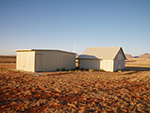
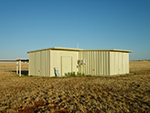
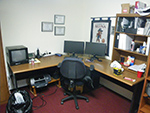
a separate clubhouse building or trailer. In late 2013 and early 2014, the Control Room was significantly expanded to the west so that it now measures 14 x 26 feet (outside dimensions). The windows were removed, and the door situated to the south out of the path of the main wind direction. A heavy duty door with a heavy duty screen was installed. Added to the expanded Control Room is a large separate Storage Room for infrequently used tools and spare equipment. Most of the large accumulated tools and equipment (such as fence post driver, fence posts, pickaxe, spare wood beams, and tarps) were removed from the Observatory Building and placed in the Storage Room vastly improving the look and cleanliness in the Observatory Building itself. In the Control Room are nice furnishings, including a
carpeted floor, microwave, refrigerator, couch, storage cabinets, bookcases, and a Control Console with computer and other telescope controls. The building is
thermally separate and insulated from the Observatory Building proper. There is a sidewalk running between the two buildings
and a convenient concrete pad enabling one to step out of the
car onto a concrete surface, never having to actually step on
the ground. Tool boxes are situated in both the Control Room and Observatory Building containing important often used tools - hammer, tape measure, screw drivers, electric drill, duct tape, wrenches...
| Back | | Next |
|
||||||||
 |
|||
Copyright © 2013 The Grasslands Observatory. All rights reserved. |
|||